Hotel content marketing: blog ideas that bring direct bookings

Hotel content marketing means publishing useful articles and photos on your own website that answer what travelers search for while they plan a trip, before they choose where to stay. For a small hotel, B&B, or agriturismo (a farm stay) in Italy, the form that works best is a blog about your area, written in the language your guests search in. People find you through the answer, get to know you, and book on your site instead of through a booking site that takes a commission.
Here’s how it looks. A couple in Chicago are planning their first trip to Tuscany. They type “things to do near Lucca in 3 days” into Google and find an article about the hill villages, a good place for dinner, and the walk along the city walls at sunset. At the bottom of the page they see who wrote it: an agriturismo twenty minutes away. Guess where they book.
Should a hotel have a blog?
Yes, if you want bookings from people who don’t know your name yet.
Your main pages (rooms, services, location, contact) only work for people who already know you or search for you by name. But people plan a trip in a set order: first what to see and do, then where to sleep. A blog reaches them in the first step, while they are still choosing the area and nobody is comparing prices yet: “romantic weekend in Tuscany,” “agriturismo with pool for families near Pisa,” “wine tasting Montepulciano.” On searches like these, your room pages have nothing to say.
When is it too early? If your website is slow, dated, or hard to book on, fix that first, because the blog sends people there. And if you can’t publish regularly, start with one well-made guide to your area: it beats ten rushed posts.
What hotel content marketing gets you
- More direct bookings, less commission. Every guest who finds you through an article and books on your own site is a booking that pays no commission to Booking.com, Airbnb, or Vrbo. A blog is one of the steadiest ways to increase direct bookings.
- Trust before the first message. Someone who has read three of your articles reaches your booking page already convinced that you know the area and care about the details.
- Material for social media and your newsletter. One article becomes five posts and an email.
- Visits that keep coming. A good article can bring visitors for years. An ad stops working the day you stop paying.
Most of it starts with search. Your main pages rank, at best, for your name and “agriturismo + your village.” Every article is a new way in, found by people searching for the places around you: exactly the people who could stay with you. That’s why content marketing for hotels and SEO are one job. For the rest of the picture (page titles, keywords in two languages, map results), see how guests find hotels on Google. The same pages can also be quoted by AI assistants such as ChatGPT or Gemini when a traveler asks them for advice.
A real example: a B&B in Tuscany, 30% more direct bookings
I worked with a B&B in Tuscany that had never published anything about its area. In June 2024 the owner and I started publishing articles about the villages nearby, food and wine routes, and local events.
The work ran until December 2024. During those months the site started to climb in Google for the searches it was targeting, and after the articles went live, direct bookings went up 30%.
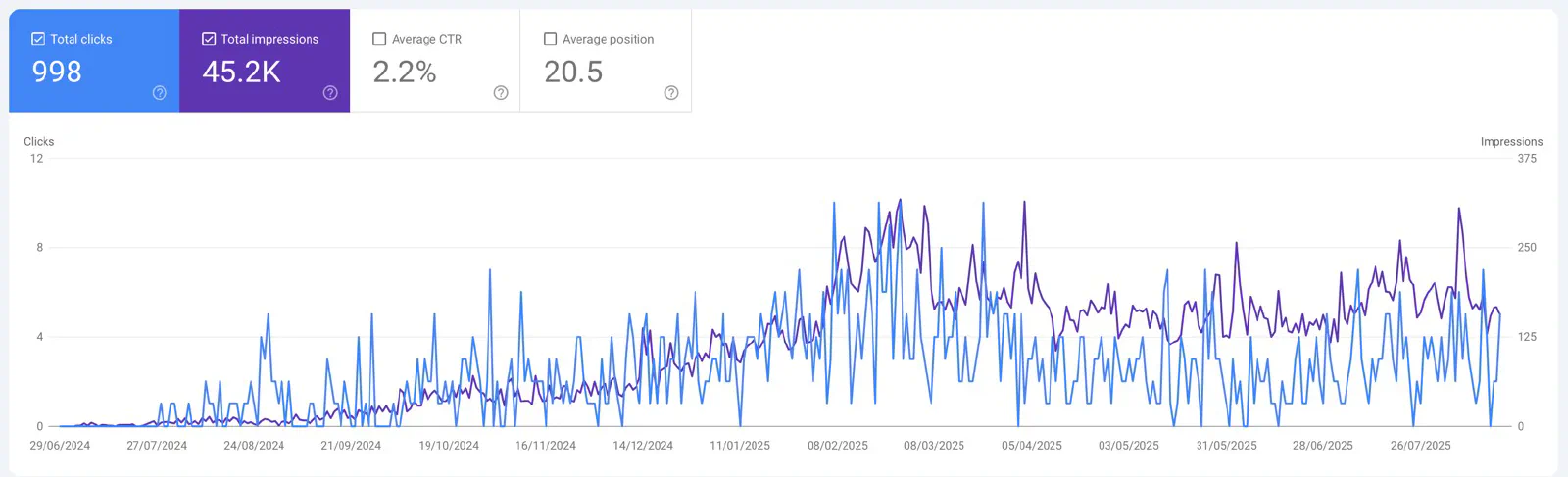
Traffic grew month after month and kept coming after the work ended: the chart runs to summer 2025, more than a year after the first articles went live, and the site was still getting clicks from Google every week.
Want to know which searches your property could rank for?
Hotel blog ideas, with example titles
The articles that bring the most bookings are rarely about the property. They’re about the area, and from there they lead naturally to you. Here are four kinds that work, with example titles for a property near Lucca; swap in your own places. The same ideas work for a B&B, a villa, or a vacation rental (a holiday let, in the UK).
Guides to your area
You live there, so you’re the local expert, and no booking site can compete with that.
- Things to do near Lucca in 3 days
- The most beautiful villages in the Garfagnana, north of Lucca
Experiences at or around your property
The tasting you run, breakfast with cheese from the farm next door, the trail that starts at your gate. This is where you show why someone should stay with you and not ten kilometers away.
- What a day of olive picking at an agriturismo looks like
- A cooking class in the Tuscan hills: what you’ll make and what to bring
Answers to practical questions
People who search for these are already planning their stay.
- How to get from Pisa airport to [your village] without a car
- When is the best time to visit the Garfagnana?
Seasonal events
Events give people a reason to pick a date.
- Tuscany in November: sagre (village food festivals) and the new olive oil
- Grape harvest in Chianti: when it happens and how to join in
Skip diary posts such as “Pool cleaning day.” They can work on social media for people who already follow you, but nobody searches for them on Google.
Write in the language your guests search in
An article in English reaches the couple in Chicago at “things to do near Lucca”; one in Italian reaches Italian weekenders at “cosa vedere vicino a Lucca.” Start with the language most of your guests speak, and have every translation checked by someone who speaks it. A stiff machine translation won’t convince anyone to book.
Sell the destination, not the room
A guest looks at three photos of your room, the price, and a “generous homemade breakfast,” then closes the page. The room was fine; you just didn’t say why this corner of Tuscany is worth the trip. Your area is that reason, and the one thing your competitors can’t copy. Selling it changes three things:
- Fewer direct competitors. Ten agriturismi in the same valley compete on price as long as they all sell “a room with breakfast.” The one that becomes “the base for walking the Via Francigena” leaves that comparison.
- A reason to pay more. A partner winery 2 km away, a shuttle to the station, a trail map ready at reception: the higher rate stops looking like a surcharge and starts looking like a service.
- Longer stays, even outside peak season. A room sells one night. An area sells three: the village today, the winery tomorrow, the trail the day after. Walkers on routes like the Via Francigena are one of the niches in how to increase hotel occupancy in low season.
One detail can be worth bookings. A property owner I worked with in the province of Pistoia never mentioned that the train station was a few minutes’ walk away. To him it was obvious. Once the website and social media said so, with the walking time and the direct trains, bookings started coming from people who wanted a base for Florence without a car. The point was not having the station. It was saying so.
Almost every property has an advantage like that. It usually falls into one of four groups:
- Practical: train stations, highway exits, airports, parking. Boring, which is why it works: it answers a real worry.
- Nature: trails, lakes, hot springs, viewpoints, nature reserves. In Tuscany this is often the most underrated group. The Padule di Fucecchio, the largest inland marsh on the Italian peninsula, is barely covered online, yet every property around it could write about it. I’ve been there several times as a licensed hiking guide, and once to photograph a stork release.
- Culture: villages, country churches, historic villas, museums, festivals. You don’t need a cathedral: the village nobody knows yet often wins.
- Food and wine: wineries, olive mills, cheese makers, local restaurants. These turn most easily into experiences guests can book.
If you grew up here, you may not notice these things anymore. If you moved here from abroad, think back to what surprised you in your first year: tasting the new oil at the frantoio (the olive mill) in November, the sagra in the village square, the frescoed church at the end of a dirt road. That’s what your guests want to read about.
Pages about your area also help you in local search. Listings, consistent contact details, and being found in both Italian and English are covered in my local SEO guide.
How to choose topics people actually search for
Start from what is around you and what people really search for, not from what you feel like writing.
- Map your area. Mark everything within 30 to 40 minutes of your property: villages, trails, wineries, restaurants, events. The list is usually twice as long as you expected. Start with the three places nobody describes well.
- Find the real searches. Free tools are enough: the suggestions Google shows as you type, the “People also ask” box, and, once your site has some traffic, the queries in Google Search Console.
- Choose specific searches over broad ones. Every property in the region and all the big booking sites compete for “agriturismo Tuscany.” Fewer people search for “farm stay with animals for kids near Lucca,” but they know exactly what they want, and a small property can rank for it.
- Answer one question per article, with specifics and your own photos. Not “a land rich in history and traditions” but “a Medici bridge from 1599 is 1.2 km away, on foot along the river.” Give distances in minutes, and photograph the places in the same style as your rooms, not with stock photos.
- Cover the SEO basics. The main search phrase in the title and first paragraph, clear subheadings, and alt text that describes each photo. Link every article to your rooms and booking page: it helps Google find the pages that matter most, and it gives readers a next step.
- Publish steadily, then measure. One or two articles a month beat ten in one week and then nothing for a year. After three months, check in Search Console which articles get clicks, and write more of what works.
Do it yourself, or get help?
You can start on your own; the hard part is making a blog bring bookings. The usual story is a few months of rushed articles with no plan, then the owner gives up, convinced that blogs don’t work, when what was missing was a plan.
A hotel blog that brings bookings needs a content plan, SEO, strong photos, and writing that makes people want to come, all telling the same story. That’s easier when one person handles all of it. It’s how I work on SEO for hotels and tourism businesses: one point of contact, from the first photo to the first page of Google. I tested the method on my own tourism project, a hiking-guide website I built from zero: pages written around the questions people type into Google, steady publishing, no ads. The case study shows the Search Console charts and the direct bookings it brought.


