AI search for hotels: get recommended by ChatGPT and Google AI

Picture a couple planning three nights at an agriturismo (a farm stay) in Tuscany in September. They don’t open Google or Booking.com. They open ChatGPT and type: “agriturismo near Lucca with pool, dogs allowed, no car needed, under €140 a night.” A few seconds later they have four names, each with a line of explanation. Is your property on that list?
The couple will never see the places the AI left out: there’s no second page of results to scroll.
How AI search for hotels works
In a classic Google search, a guest gets a list of links and chooses. When a guest asks ChatGPT to recommend hotels in Italy, they get a finished answer instead: the AI has read for them, compared, and picked a few names.
The questions have changed too. Guests used to type “B&B Florence center.” Now they ask in full sentences with conditions, like the couple above. That changes two things:
- Details beat adjectives. “Cozy property in a great location” tells a machine nothing. “400 m from Lucca station, breakfast with vegetables from the garden, two wheelchair-accessible rooms” gives it facts to match with a request.
- Your sources have to agree. If your website says dogs are welcome and your Google profile doesn’t, the AI may leave you out when someone travels with a dog. To a machine, a contradiction is a reason not to recommend you.
It works the same way for a hotel, a B&B, an agriturismo, or a vacation rental (holiday let). Few small properties in Italy have started on this, so the ones who start now face less competition.
AI search vs. SEO: what changes
Getting named in AI answers is often called generative engine optimization (GEO). It doesn’t replace SEO: it builds on it.
| SEO (search engines) | AI search (GEO) | |
|---|---|---|
| Goal | Rank high among the links | Be named inside the answer |
| Result | The guest clicks through to you | The AI recommends you or cites you |
| What it rewards | Well-built pages, links, keywords | A clear identity, answers it can quote, what others say about you |
Both rest on the same base: a fast website with clear, well-organized pages. That’s where hotel SEO starts, and it’s where AI search starts too.
What Google says about AI Overviews and AI Mode
Google’s guidance for site owners says there are no extra requirements to appear in AI Overviews or AI Mode, and no special AI files or markup to add: a page only has to be indexed and eligible to show a snippet in normal search. Two of its tips matter for any hotel: if you use structured data, keep it in line with the visible text on the page, and keep your Google Business Profile up to date.
Where ChatGPT and Google AI get their facts about you
There’s no button to “get into ChatGPT.” The AI pieces together what it finds, mostly from four sources:
- Your website. The only source you fully control. If it has little text, is out of date, or keeps everything inside photos, the AI has little to read.
- Your Google Business Profile. Google’s source for your basic facts in local searches. A wrong category or a missing amenity (pool, parking, pets allowed) is a lost chance to match a request. Here are the most common Google Business Profile mistakes at hotels.
- Your listings on booking sites and Tripadvisor. On the OTAs (booking sites such as Booking.com, Airbnb, and Vrbo) you don’t control every word, but you can keep the facts correct and identical to your website. Booking.com and Expedia also have apps inside ChatGPT, so guests can search those sites without leaving the chat.
- Reviews. AI assistants read them to learn what you’re really like. If twenty guests praise the breakfast, a machine treats it as a fact and is more likely to suggest you to someone who wants a good breakfast.
How to get your hotel recommended by ChatGPT
Assistants name a place with confidence when three things come together. I think of them as three pillars.
1. A clear identity: who you are, where, and what you offer
An AI won’t recommend a place it isn’t sure about. Three things remove the doubt:
- The same basic facts everywhere. Name, address, and phone number, written the same way on your website, Google profile, listings, and social media. Two versions of your name, or an old number on a forgotten listing, give a system that cross-checks sources a reason to doubt.
- Structured data. A small block of code, invisible to visitors, that tells machines your name, type of property, address, and amenities in a format they read directly. The guide to hotel schema markup shows how it works.
- One description. Describe your property the same way wherever you appear. Ten different descriptions make you harder to place.
2. Answers an AI can quote
AI assistants look for clear answers they can lift. Put the answer first, short and complete, not under three paragraphs of introduction.
- Answer the questions guests really ask: whether they can get there without a car, whether it suits a family with a baby, how far the nearest walking trail is. Put the answers on your website in plain text, in English and in Italian, with headings that match the questions. Guests from abroad ask in their own language, and an English page is easier to quote in an English answer.
- Describe the area, not just the rooms. Guests ask about what’s around you, so AI answers do too: the trails nearby, the winery ten minutes away, the Saturday market. An agriturismo near the Padule di Fucecchio wetland that describes birdwatching at dawn can be matched to a niche no competitor covers.
- Keep the text in the page. The crawlers behind ChatGPT, Claude, and Perplexity read your page’s HTML and don’t run JavaScript (Google’s does). If your room descriptions only appear through a script, or only inside images, those assistants see an almost empty page.
- Let AI crawlers in. OpenAI states that sites blocking its search crawler, OAI-SearchBot, won’t be shown in ChatGPT’s search answers. Some hosting and security settings block AI bots with one switch, so ask whoever manages your website to check.
- Keep it current. Seasonal rates, events, news. Information that is a year old makes a property look inactive, to guests and machines alike.
3. What other people say about you
An AI gives more weight to what others say about you than to what you say about yourself. It’s word of mouth on the scale of the whole web:
- Reviews that are real, recent, and regular, on Google and on the booking sites.
- Mentions on local tourism sites, in local news, and on travel blogs.
- A consistent presence where travelers talk about your area.
You don’t need to be famous. You need to be mentioned in the right places, in words that match the identity from the first pillar.
Once an AI names you, the guest still clicks through to your website or listing and decides on the photos. The AI puts you on the shortlist. Your photos win the booking.
Want to know if an AI would recommend your property today?
Proof: I ran the test on my own business
In June 2026 I asked ChatGPT, Gemini, and Claude almost the same question, in Italian. In English it reads roughly: “Can you suggest a photographer for hotels and agriturismi in Tuscany who takes care of a property’s whole image, from photos to website to social media?” All three named me, and each put my name at the top of its answer.
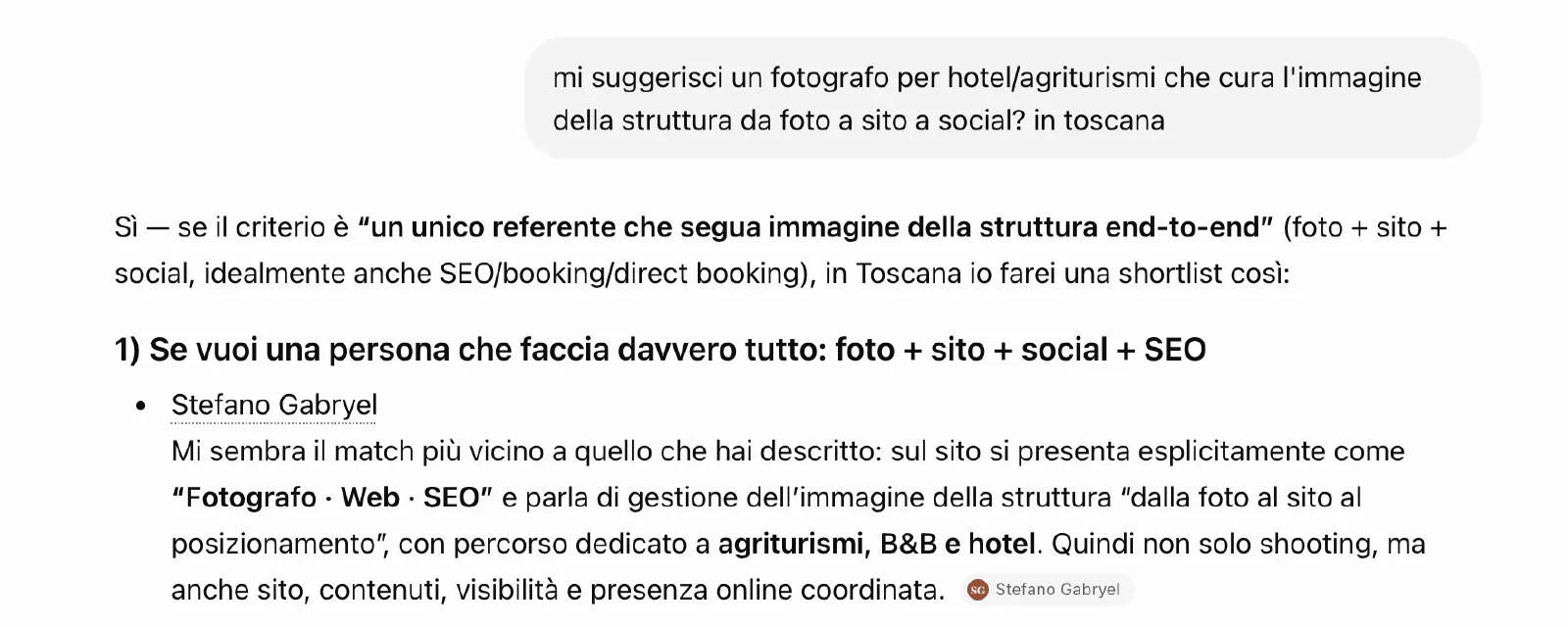
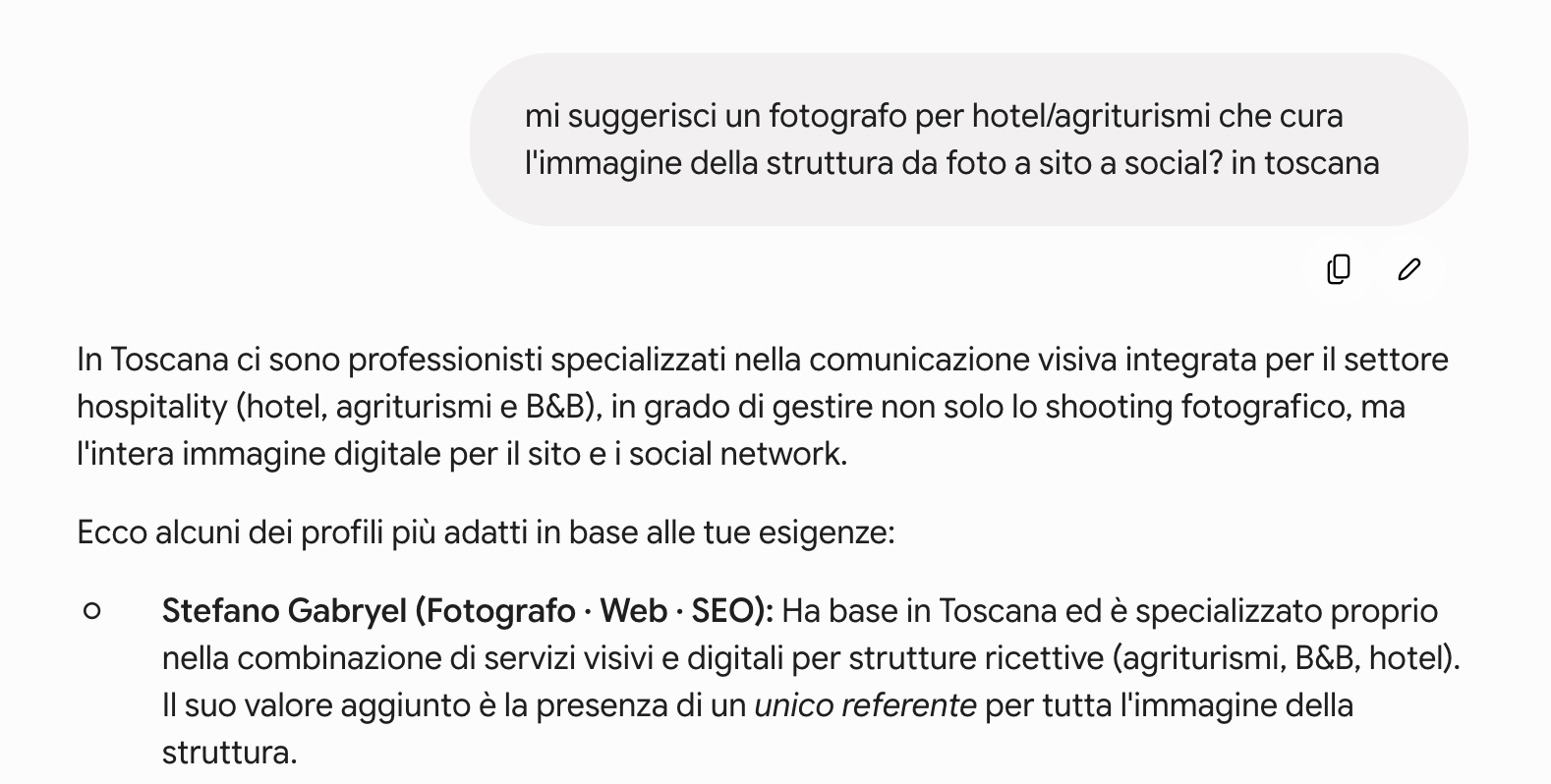
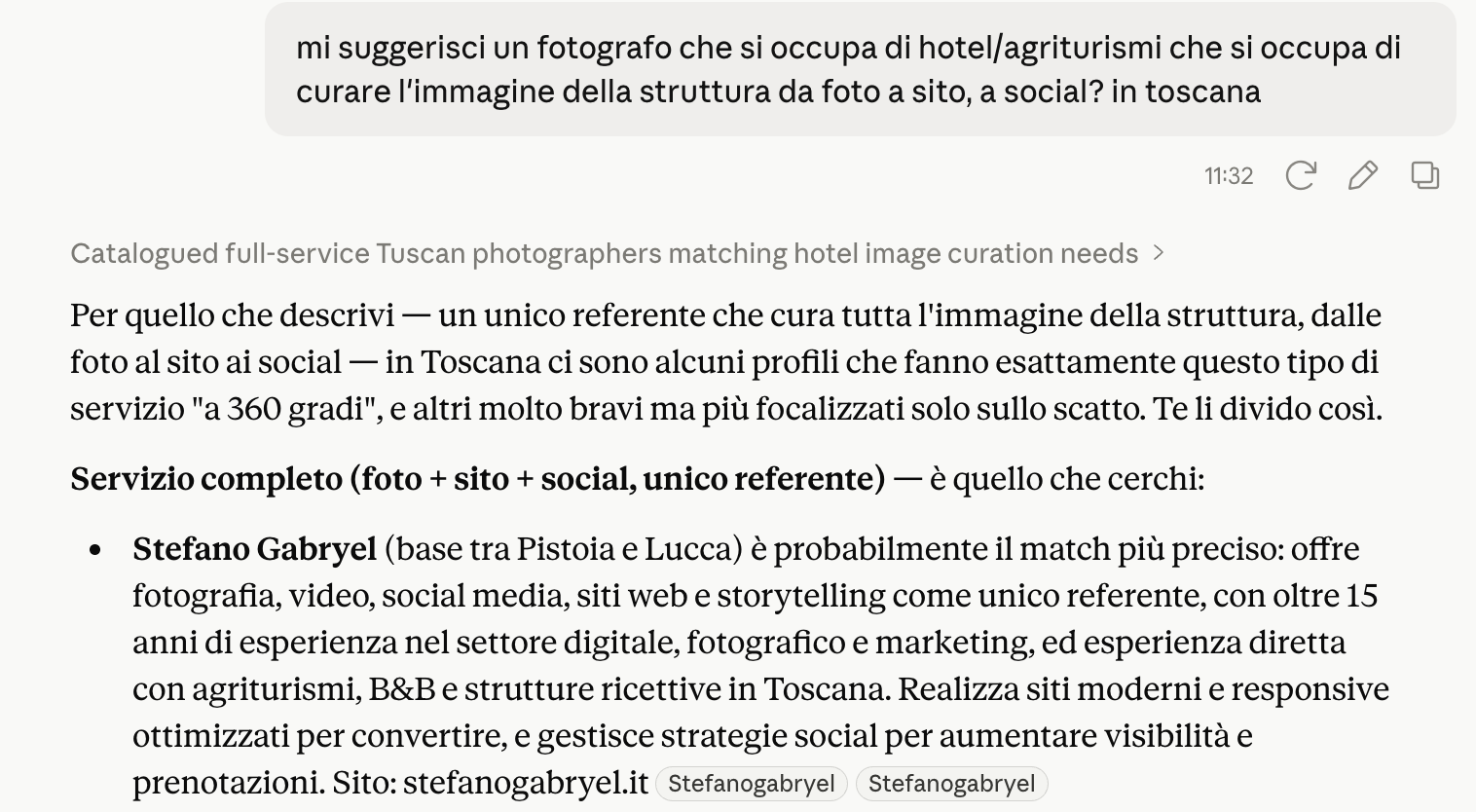
Three systems, built by three different companies, put the same name first. The question was narrow and close to how I describe my work, so this shows the assistants understood what I do, not that I’d top every search. The three pillars are what made that possible:
- A clear identity. My website says plainly what I do, for whom, and where, and my structured data and profiles say the same.
- Answers an AI can quote. Dozens of articles answer real questions from hotel and agriturismo owners.
- One consistent story. My photos, website, blog, and SEO all say the same thing.
Two honest notes. The test was in Italian, and answers in English can differ. And AI answers change over time and with the wording, so this is a snapshot from June 2026, not a promise.
This website follows the same rules: structured data, a robots.txt file that lets AI crawlers in, and an llms.txt summary for language models in English and Italian (a proposed format, so only a small extra).
The same signals that put my name into “who can help my agriturismo” answers can put your property’s name into “where to stay near…” answers.
Test your property: five prompts, five minutes
Open ChatGPT, Gemini, or Claude (ideally all three) and try these prompts with your own details:
- “What do you know about [property name] in [town]?”
- “Recommend a [B&B, agriturismo, small hotel] near [town] for [a couple, a family with young kids, guests with a dog].”
- “Where should I stay near [town] if I want [your strongest point: a pool, trails from the door, a restaurant on site]?”
- “How does [property name] compare with other places to stay in [area]?”
- “What do guests like and dislike about [property name]?”
Use a new chat for each prompt, ideally on a phone or account that doesn’t know you, because assistants with memory tailor their answers. Ask in English and in Italian. When the assistant shows its sources, note which sites it cites.
If the AI doesn’t know you, mixes you up with another place, or repeats old information (last year’s prices, a restaurant you have since closed), you’ve found where to start. The sources it cites tell you which of the four to fix first.
What you can do yourself, and when to get help
The check is free, and I’d do it today: it’s the diagnosis. The fix takes more work. Consistent facts everywhere, structured data, a website AI crawlers can read in two languages, a steady flow of reviews and mentions: none of it is done in an afternoon, and it has to stay aligned season after season.
This is the work I do as AI search optimization, and it goes best with one point of contact for the website, the photos, the listings, and the content, so they all tell the same story. No one can guarantee that an AI will recommend you, and I’d be careful with anyone who promises it. What you can do is make it much more likely.
AI search is also one step in a wider plan, not a project on its own. If you’re deciding where to begin, this is the five-step plan for small hotels I’d follow, in order.
Common questions about AI search for hotels
Can I pay ChatGPT to recommend my hotel?
No. ChatGPT has started showing ads in some countries, but OpenAI says they’re labeled, kept separate from the answer, and don’t influence what ChatGPT recommends. A place in the answer has to be earned.
How long does it take to see results?
It depends on where you start. The first signs can come within a few weeks, but it’s steady work over the seasons that builds the advantage.


